A woska take on a thread by Hamza Khalid.
Read the original on X (Twitter)An agent you prompt does what you asked. An agent you trust does what you asked, tells you when it's not sure, and says so before it acts on something that might be wrong. That gap — between an agent that answers and one that's actually safe to hand real work to — is the through-line in one builder's account of running a personal AI agent continuously for months, not as a demo, but as something meant to handle real inbox, calendar, and research work.
The failure that doesn't look like a failure
The most useful part of running an agent long enough isn't the wins. It's watching it fail in a specific, repeatable way: confidently stating something that used to be true. An agent reading from a cached export of a CRM, a document, or an inbox has no built-in sense of how old that snapshot is — it presents last week's numbers with the same tone as this morning's. Nothing in the output looks wrong. That's what makes it dangerous: a wrong answer that reads like a right one doesn't get double-checked.
The fix isn't "be more careful with prompts." It's making the agent treat freshness as a fact it has to report, every time it uses data it didn't just pull live: how old is this, and is that too old for what I'm about to say.
Identity first, then memory
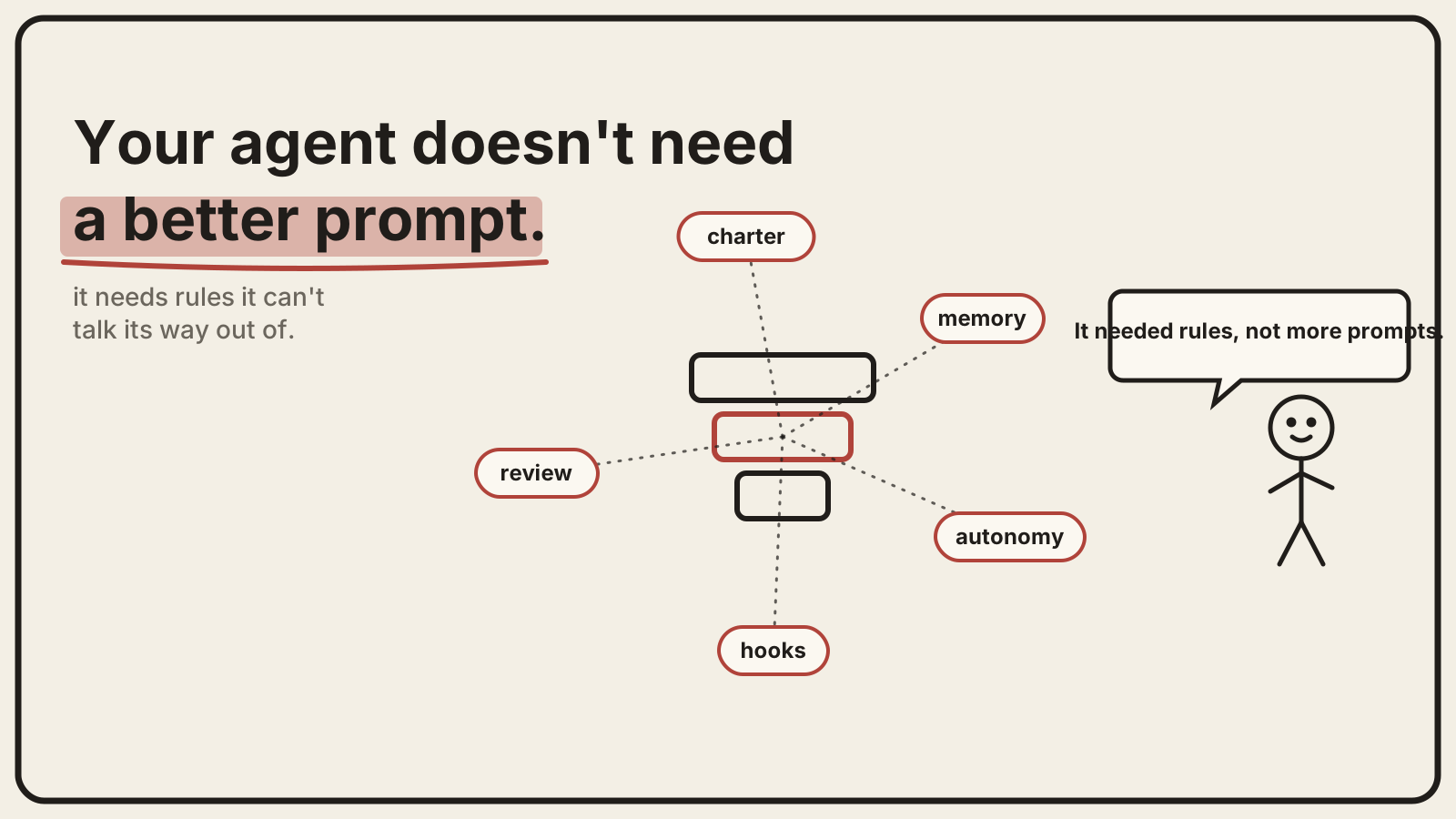
Before any of that works, the agent needs a stable sense of itself — closer to a written charter than a system prompt. A charter explains why the rules exist, so the agent can reason through a situation nobody anticipated instead of inventing a policy on the spot. A list of commands has nothing to fall back on once the list runs out, and it always runs out.
On top of identity sits memory, and the mistake most people make here is treating memory as one growing file. Split by domain instead — what's true about ongoing work, what's still an open question, what's waiting on a decision from you — and the agent can load only what's relevant instead of re-reading everything every session. A single file that just keeps growing becomes something nobody, human or agent, can actually search.
Autonomy is a map, not a feeling
The single most load-bearing design decision is deciding, explicitly, what the agent can do without asking and what always needs a human yes. Not by vibes — by mapping every action to how reversible it is. Drafting an email is reversible; approve it by default. Sending one to a client, or moving money, is not; that always waits for a person, regardless of how confident the agent sounds.
Skip this step and you get one of two bad outcomes: an agent that pings you for permission on everything, which trains you to stop reading the pings, or an agent that quietly takes an action you'd have stopped if you'd seen it coming. Both failure modes come from the same missing piece — nobody wrote down where the line actually is.
Corrections are supposed to change the system
The habit that compounds fastest is what happens after a correction. Fix something in the chat and it's fixed for that conversation and gone by tomorrow. Fix it in the agent's actual configuration — the charter, the memory structure, an explicit rule — and it's fixed permanently. Correcting the same mistake three times across separate sessions isn't a stubborn agent; it's a missing rule that hasn't been written down yet.
What this looks like for a small business, not a hobby project
None of this requires an engineering team. It requires treating the agent less like a chat window and more like a new hire: give it a clear brief on what it owns, a plain answer to "what can you decide without me," and a habit of writing down what it got wrong so it doesn't happen twice. Start with one workflow — inbox triage, a weekly report, first-draft replies — and get the freshness and autonomy rules right there before adding a second one.
*Read the original thread this piece is based on: Hamza Khalid on X.*
Source: Hamza Khalid · X (Twitter)
Read the original