A woska take on a thread by Anatoli Kopadze.
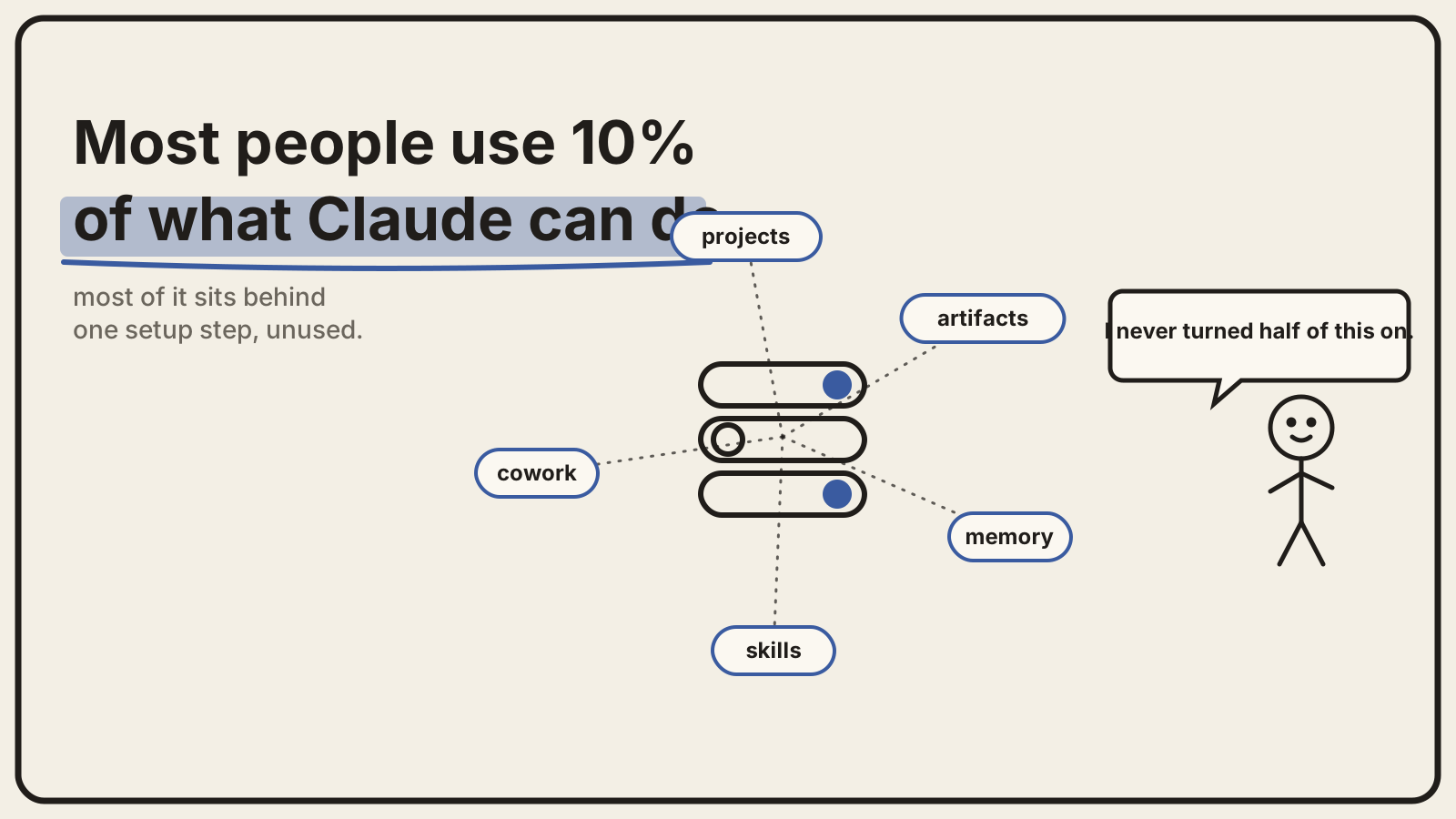
Read the original on X (Twitter)The single biggest gap between people who get a lot out of Claude and people who get a little isn't skill — it's that the second group never gets past chatting with it. A useful round-up of Claude's less-obvious capabilities makes the same point over and over in different forms: most of what makes Claude genuinely useful sits behind a one-time setup step, and most people never take it.
The memory problem, solved twice
Open a fresh Claude chat and it knows nothing about you — not your job, not your project, not a conversation from yesterday. Most people just accept this and re-explain themselves every time. Two separate features fix it in different ways. Projects let you attach standing instructions and reference documents to a specific piece of work, so a conversation about the same project next week starts exactly where the last one left off. Memory works more broadly, building a running profile — your role, your preferences, what you're currently working on — that a brand-new chat can draw on without you introducing yourself again. Between the two, the "starting from zero every conversation" problem mostly disappears.
It builds things, not just describes them
A lot of people think of Claude as a text generator and stop there. Artifacts are the feature that breaks that assumption: instead of a block of code you copy somewhere else, Claude can build something that runs right there in the conversation — a working calculator, an interactive chart, a small tool — that you click and use immediately. It's available on the free tier and most people who've used Claude for months have never tried it once.
A reasoning mode worth turning on for real decisions
For a quick factual question, Claude's default response is fine. For something genuinely difficult — a strategic call, a decision with real tradeoffs — there's an extended reasoning mode that works through the problem step by step before answering, and lets you see that reasoning rather than just the conclusion. It's not something to leave on for everything; it's something to reach for specifically when the stakes of getting the answer wrong are higher than the few extra seconds cost.
Giving Claude a job description changes how it argues with you
By default, most assistants — Claude included — lean toward agreeable. Ask about a plan and you tend to get validation plus a few supportive bullet points. Assigning Claude an explicit role at the start of a conversation changes that behavior more than most people expect: framed as a skeptical reviewer, it starts finding the weak assumption instead of complimenting the plan; framed as a stand-in for a specific person in a hard conversation, it pushes back the way that person actually would. The prompt is doing less work than the framing — a role told to disagree, disagrees.
Past the chat window entirely
The features that go most unnoticed are the ones that leave the chat interface altogether. A browser extension gives Claude visibility into whatever page is open, so it can read, click, and fill things in without you copying content back and forth by hand. A desktop app extends that further, with direct access to files on your own machine rather than everything routed through a chat box. Scheduled tasks let a job run automatically — every morning, every Monday — without you starting it. Installable skills work like plugins, giving Claude specific new capabilities without you re-explaining them every session. And for anyone touching code, Claude Code moves the entire interaction into the terminal and the actual codebase: real edits, real tests, real fixes, in a loop, rather than a chat about what the code should probably do.
The pattern underneath all of it
None of these are complicated to turn on. What they have in common is that they require a decision — set up a Project, write a role at the top of a chat, install one skill — before the benefit shows up. Chat-only use skips every one of these decisions by default, which is exactly why it's the default experience most people never grow out of. Picking even one of these to actually configure this week does more for how useful Claude is to you than a better-written prompt ever will.
*Read the original thread this piece is based on: Anatoli Kopadze on X.*
Source: Anatoli Kopadze · X (Twitter)
Read the original