A woska take on a thread by Avid.
Read the original on X (Twitter)A model doesn't have to win every benchmark to be the right one for a job — it has to win the benchmark that matches what you're actually asking it to do. That's the argument behind one builder's choice of Kimi K3, Moonshot AI's newly released open-weight model, as the engine for a fairly ambitious project: a working "company OS" that lets several AI agents operate under one shared structure instead of each running loose in its own chat window.
Picking the tool for the job, not the leaderboard
Kimi K3 is a large, open-weight model, and by most general reasoning benchmarks it isn't the strongest model available. Where it reportedly holds up well is a narrower, more practical skill: surviving a long agentic session — many tool calls, many steps, real state to keep track of — without losing track of what it was doing partway through. That's a different capability than acing a hard math problem in isolation, and it's the one that actually determines whether an autonomous coding agent stays useful for an hour instead of ten minutes.
Open weights matter here for a second reason beyond capability: they mean you can run and inspect the thing yourself instead of renting access to someone else's black box, which is a meaningfully different commitment when you're planning to run agents against it continuously.
Why a company needs an "OS" at all
The deeper argument isn't really about which model to use — it's about what happens once an agent can spend money, ship code, or hire other agents on your behalf. At that point you're not running a chatbot anymore, you're running something closer to a company, and a company without a few things in place is really just a liability with a nice interface.
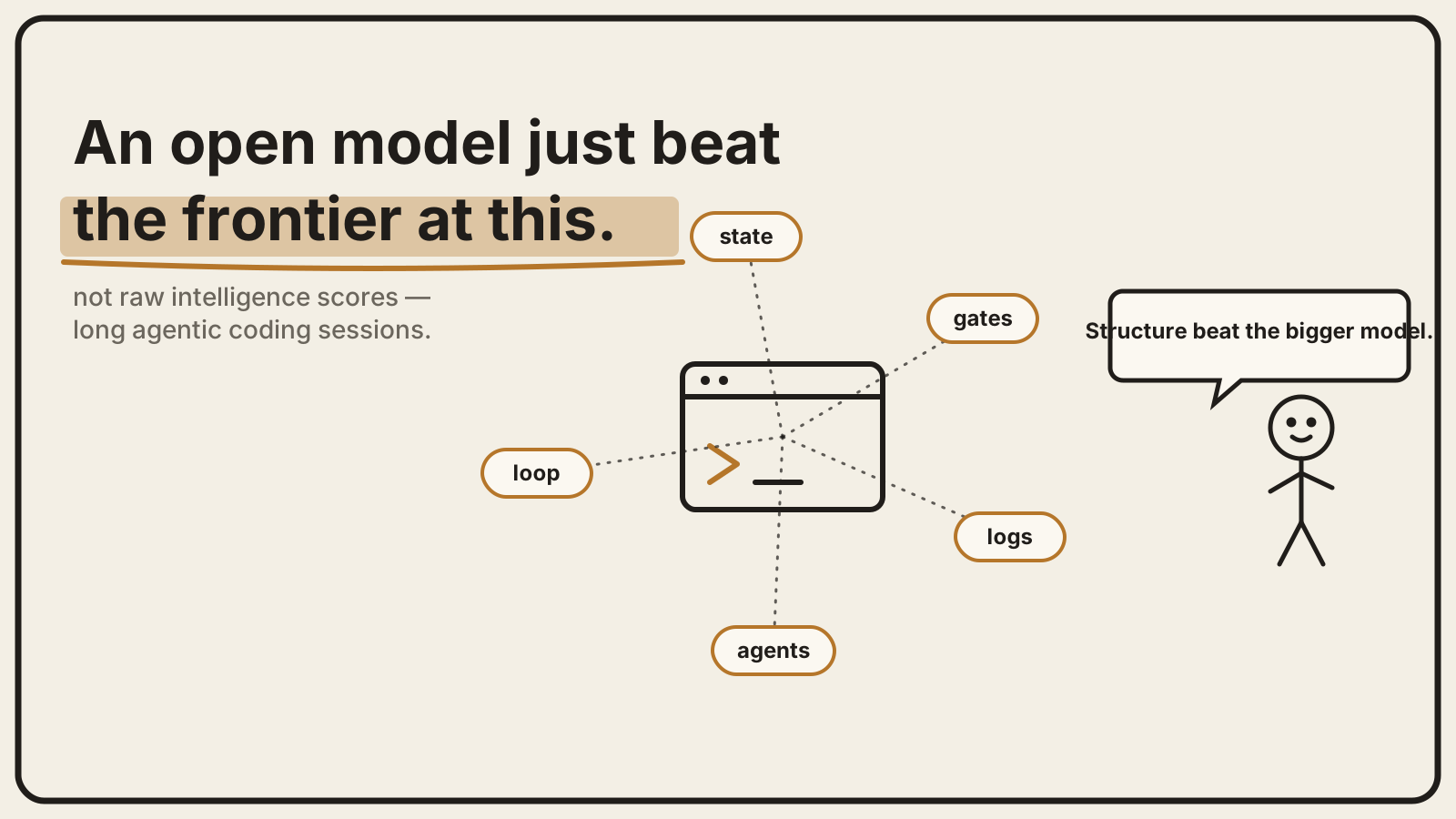
Three things came up as non-negotiable in the build: one shared source of truth instead of five components each holding their own copy of "what's true" and slowly drifting apart; a gate that anything risky — spending, hiring, publishing, deleting — has to pass through, with a real decision logged against it rather than resolving itself quietly; and a permanent, append-only log, because if it wasn't written down, as far as the system is concerned, it didn't happen.
The uncomfortable part: the fence around the real agent
The riskiest single piece of this kind of system is the point where a simulation stops being a simulation and a real agent — one that can actually think and actually spend — gets wired in. The builder's answer wasn't more trust in the model; it was walls around it regardless of how good the model is: only one agent run at a time, a cap on how much input it can be handed at once, a hard timeout so a stuck run can't hold things up indefinitely, its own isolated workspace so it can't touch anything it shouldn't, and a strict rule that no credential or token ever appears in anything the agent sends back out.
That list is worth sitting with, because none of it is about the model being smart enough. It's about the fact that no model, however capable, should be trusted with unlimited concurrency, unlimited input, and no timeout — the failure mode there isn't a wrong answer, it's a runaway process.
The lesson that outlives this specific model
Model releases move fast enough that whatever tops a given benchmark this month won't for long. The part of this worth keeping regardless of which model you're running is the shape of the system around it: a single source of truth, an approval gate for anything irreversible, and a permanent log. Bigger context windows and newer models make agents more capable; they don't replace the need for structure that keeps a capable agent from doing damage at the exact moment it's most autonomous.
For anyone building agent workflows on Claude Code or another coding agent today, the practical takeaway travels well even without switching models: add the gate before you add the autonomy, not after something goes wrong.
*Read the original thread this piece is based on: Avid on X.*
Source: Avid · X (Twitter)
Read the original