Kiro wins when you want the AI to produce a requirements document, system design, and task list before writing any code — a specification that catches design mistakes early and stays in the repo as living documentation, especially strong on AWS-native projects. Claude Code wins for pointing an agent at an existing repo and letting it read the codebase, write code, run tests, and iterate on failures largely on its own. Cursor wins on raw speed — sub-200ms tab completions and up to 8 parallel agents for teams that want AI woven directly into a fast editing loop. All three cost $20/month to start; the real decision is whether you want a spec-first process, an autonomous terminal agent, or the fastest AI-assisted editor.
The three, in one line each
Kiro is a spec-driven development environment from AWS that turns requirements into a design document, a task list, and then implementation — forcing a specification to exist before code gets written, rather than after.
Claude Code runs coding tasks from the terminal with full repo context, reading a codebase, writing edits, executing commands, and iterating on test failures without requiring a planning artifact first.
Cursor is a code editor built around repo-aware chat, inline edits, and fast refactors, optimized for keeping AI inside a rapid, interactive development loop rather than running unattended.
Where each one actually wins
Kiro wins specifically for AWS-native projects and teams that have been burned by "code first, think later" — its three-document spec process (requirements, design, tasks) catches architectural mistakes at the planning stage instead of after code exists, and it generates AWS-specific infrastructure (Lambda functions, IAM permissions, DynamoDB schemas) with the right defaults baked in. Claude Code wins when the task is "go do this in the actual codebase" — it skips the planning artifact unless you ask for one, and is built to read a real repo, make changes, run the test suite, and keep iterating on failures with less hand-holding. Cursor wins on interactive speed — if the workflow is a human and an AI going back and forth rapidly inside an editor, its sub-200ms completions and up to 8 parallel agents are built exactly for that loop, versus a slower, more autonomous session.
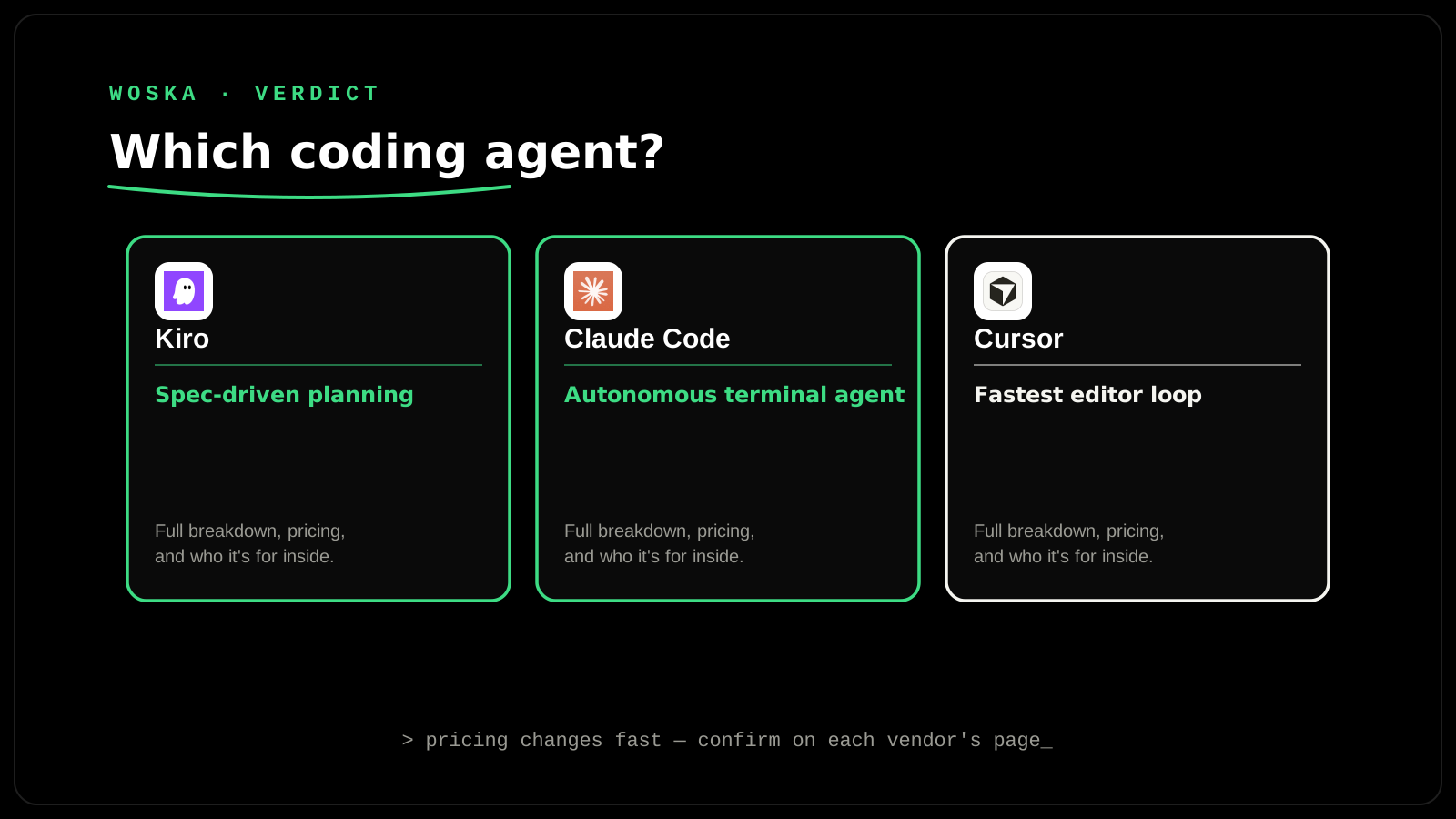
Quick comparison
| Tool | Starting price | Core job | Best fit |
|---|---|---|---|
| Kiro | $20/mo Pro (1,000 credits) | Spec-driven planning before code | AWS-native projects, catching design mistakes early |
| Claude Code | $20/mo Pro | Autonomous terminal agent on a real repo | Pointing an agent at an existing codebase to just get it done |
| Cursor | $20/mo Pro | Fast, repo-aware editor with inline AI | Rapid, interactive human-and-AI editing loops |
Which one should you use?
Choose Kiro if you're building on AWS, need GovCloud compliance, or genuinely want the AI to plan architecture before writing a line of code — the spec-driven process is the whole point, not overhead. Choose Claude Code if the task is "understand this repo and make the change" and you want an agent that can work with less supervision across reads, edits, and test runs. Choose Cursor if your workflow is fast, interactive, editor-centric development where multiple parallel agents and near-instant completions matter more than an upfront specification.
FAQ
Does Kiro's spec-driven process slow down simple tasks? Yes, for genuinely small changes the three-document process is more overhead than a quick edit needs — Kiro's value shows up most on larger or more architecturally significant work, not one-line fixes.
Can Claude Code and Cursor both run multiple agents in parallel? Cursor is specifically built around running up to 8 parallel agents in its interactive editor; Claude Code can run multiple sessions too but is more commonly used as a single focused agent working through a task in the terminal.
Is Kiro only useful for AWS projects? No, but that's where it's strongest — its spec-driven approach and architecture-first mindset are useful on any project, but the AWS-specific code generation (Lambda, IAM, DynamoDB) is a distinct advantage specifically for teams building on AWS.
Do all three require a paid plan to be useful, or is there a real free tier? All three have some free or trial usage, but the $20/mo Pro tier is where each becomes usable for real, regular work — treat the free tiers as evaluation, not a sustainable way to work.
Related guides
- Claude Code vs Cursor vs Codex vs GitHub Copilot in 2026
- How Much Do AI Coding Agents Cost in 2026?
- AI Coding & Developer Tools: The Complete 2026 Guide
- Explore Coding tools
*Ratings and pricing reviewed monthly. Last updated September 2026.*
Bogdex · Founder & editor, woska
Bogdex builds and curates woska, testing AI tools against real workflows to judge which ones actually save time rather than which have the longest feature list.