Firecrawl's job is narrow and well-executed: turn a URL, a full site, or a web search into clean markdown or structured JSON that's actually usable by an LLM or AI agent, instead of the raw, ad-cluttered HTML a generic scraper hands back. An independent July 2026 benchmark across 12 target websites and 8 competing APIs placed Firecrawl #3 with a 69% overall success rate, at an average $5.38 cost per 1,000 requests — a solid, credible result, though worth knowing it isn't the outright category leader if raw success rate is your only criterion.
What it actually does
Firecrawl ships five core capabilities: Scrape (a single URL into markdown/JSON), Crawl (an entire site, following links), Map (returning every URL on a site without fetching content), Search (web search that returns full page content, not just links), and Interact (browser automation for pages that need clicks or scrolling to reveal their real content). Built-in smart rate limiting and proxy management mean you're not separately managing the infrastructure problems that make scraping fragile at scale — a real time-saver if you're building this into an AI agent's toolset rather than running a one-off script.
Pricing
Firecrawl runs a free tier with 1,000 credits/month, then Hobby at $19/month ($16 annually) for 5,000 credits, Standard at $99/month ($83 annually) for 100,000 credits, Growth at $399/month ($333 annually) for 500,000 credits, and Scale at $749/month ($599 annually) for 1 million credits. Credit costs vary by what you're actually doing: scrape, crawl, and map each cost 1 credit per page, structured JSON extraction adds 4 credits (5 total per page), an optional prompt-injection check adds another 4, and Stealth Mode (for sites actively blocking scrapers) costs 5 credits per page. Model your actual usage pattern against these multipliers before picking a tier — a JSON-heavy extraction workload burns credits meaningfully faster than plain markdown scraping.
The honest benchmark context
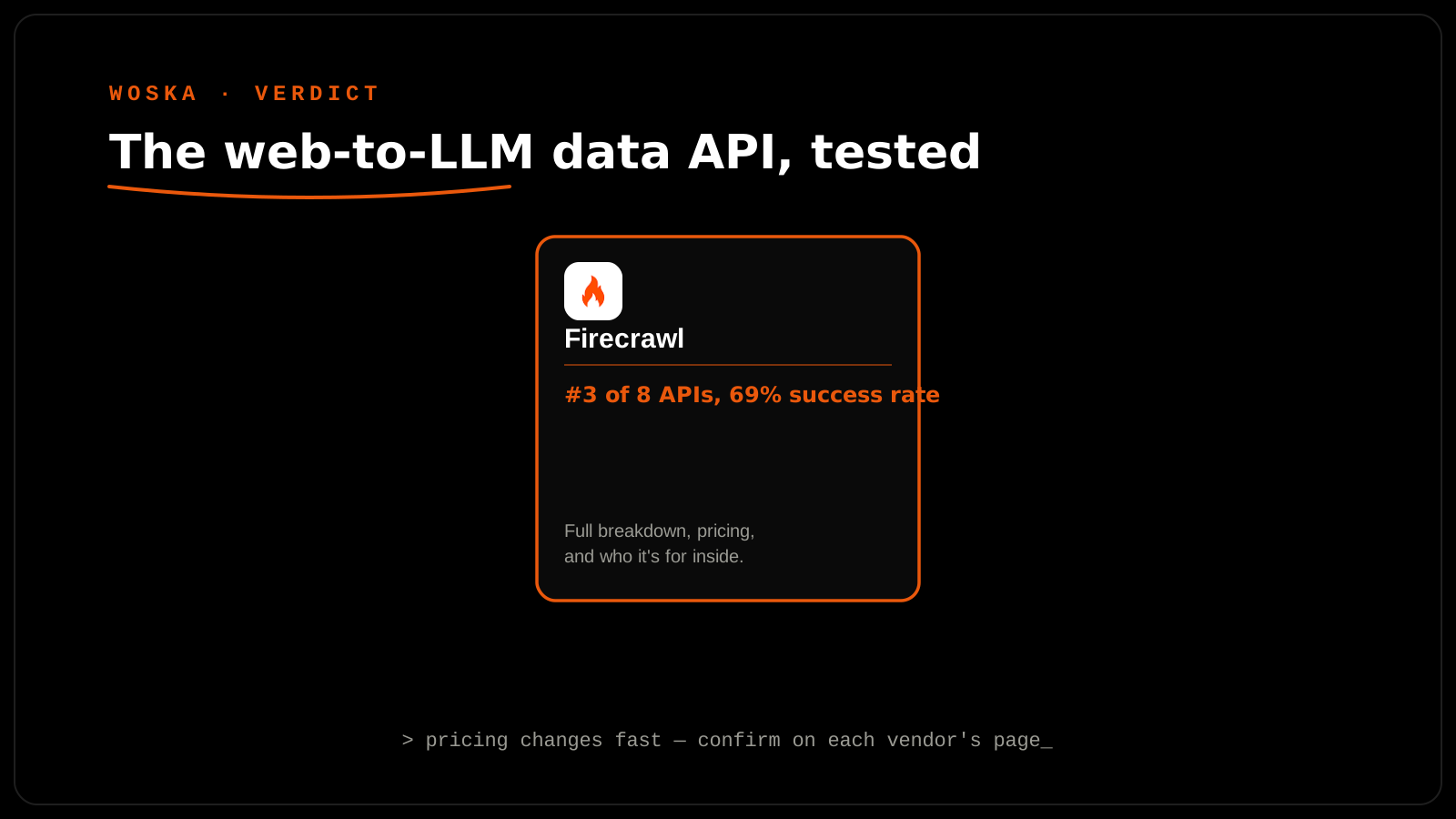
A 69% success rate and #3 ranking out of 8 tested APIs (July 2026) is a genuinely useful, credible data point — Firecrawl is solid and reliable for most mainstream use cases, but two competitors reportedly scored higher on raw success rate in that same benchmark. If your use case is scraping a small number of consistently well-behaved sites, that gap likely won't matter in practice. If you're scraping a wide, unpredictable range of sites (heavy JS, active bot-blocking, unusual markup) at scale, it's worth checking current benchmark data for your specific target sites rather than assuming any one API's aggregate score applies directly to your case.
Quick comparison
| Plan | Price | Credits | Best for |
|---|---|---|---|
| Free | $0 | 1,000/mo | Testing a single project |
| Hobby | $19/mo | 5,000/mo | Small, ongoing scraping needs |
| Standard | $99/mo | 100,000/mo | Production agent workloads |
| Growth | $399/mo | 500,000/mo | High-volume pipelines |
FAQ
Does Firecrawl handle JavaScript-heavy sites that render content client-side? Yes, via its Interact capability for browser automation and Stealth Mode for sites actively resisting scrapers — both cost more credits per page than a plain markdown scrape, so factor that into your budget for JS-heavy targets.
Is Firecrawl's output actually optimized for LLM consumption, or just generic scraping? It's specifically built to output clean markdown structured for LLM context windows, rather than raw HTML — that's the core differentiator versus a generic scraping library, and the reason it's positioned specifically for AI agent tooling.
How does Firecrawl's pricing compare to running your own scraping infrastructure? Self-hosting a scraper avoids per-credit costs but shifts the burden to you for proxy management, rate-limit handling, and ongoing maintenance as target sites change their markup — Firecrawl's pricing is effectively paying to not own that maintenance problem.
Is the free tier enough to evaluate Firecrawl for a real project? 1,000 credits/month is enough to test Scrape, Crawl, and Search against a handful of real target pages and get a genuine sense of output quality before committing to a paid tier.
Related guides
- Top 5 AI Tools for Freelancers
- Best AI Tool for Competitor Research in 2026
- Best AI Tool for Academic Research in 2026
- Explore Research tools
*Ratings and pricing reviewed monthly. Last updated September 2026.*
Bogdex · Founder & editor, woska
Bogdex builds and curates woska, testing AI tools against real workflows to judge which ones actually save time rather than which have the longest feature list.