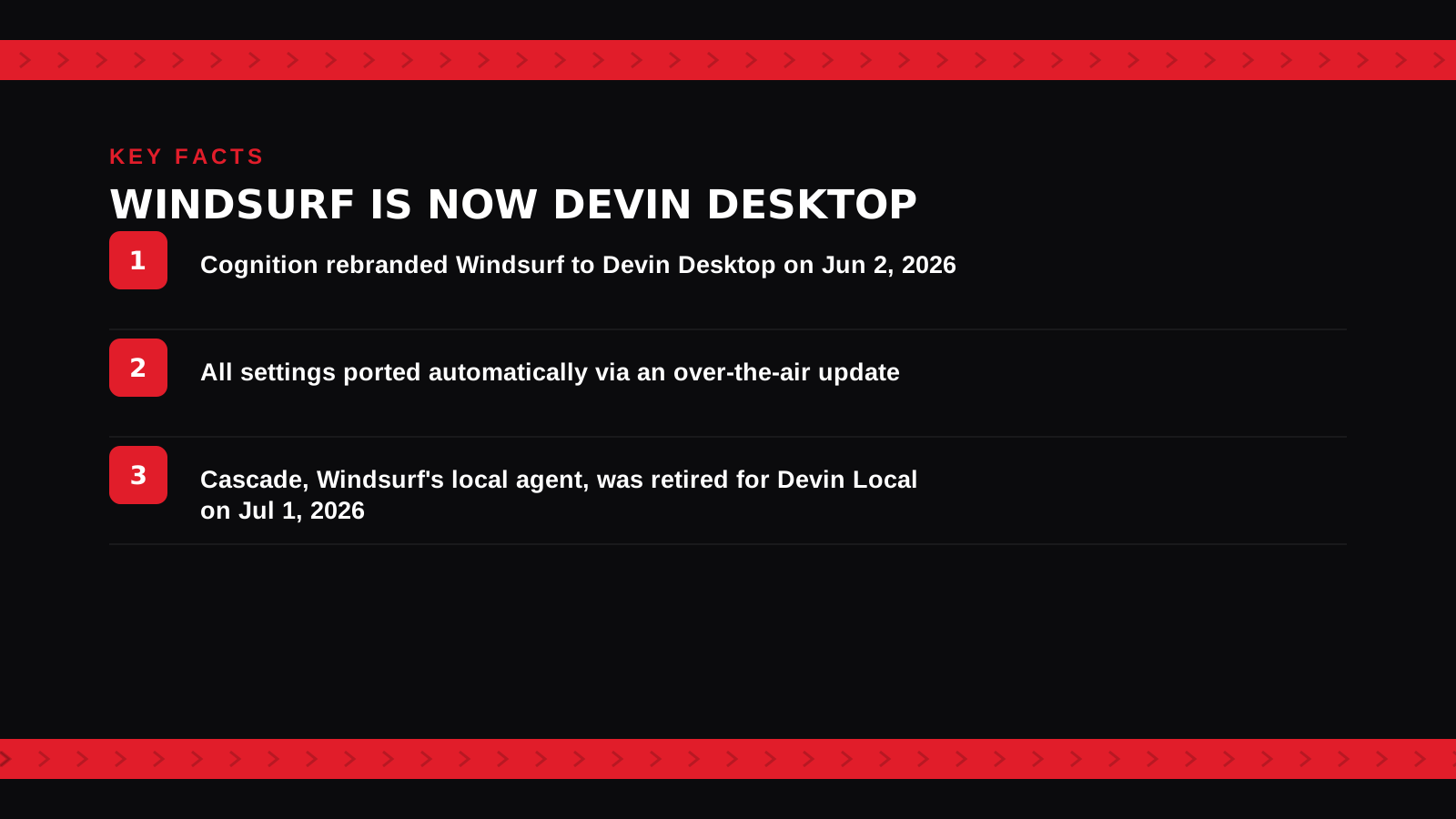
If you had Windsurf installed and it quietly turned into something called "Devin Desktop," that's not a bug or a hijacked update — Cognition, which acquired Windsurf for roughly $250M in December 2025, officially rebranded it to Devin Desktop on June 2, 2026. The change shipped as a standard over-the-air update: existing Windsurf settings ported automatically, with no reinstall required. The bigger story isn't the name — it's what the product became underneath it.
What actually changed
Cognition frames Devin Desktop as "a full IDE with an agent manager built in, not the other way around" — a meaningful repositioning from Windsurf's original identity as an AI-assisted code editor. The headline addition is the Agent Command Center, a Kanban-style view surfacing every local and cloud agent running across your work in one place, plus "Spaces" that group sessions, pull requests, files, and Git worktrees so multiple agents can share context on the same task without stepping on each other.
The most consequential technical change: Devin Desktop supports the open Agent Client Protocol (Apache 2.0 licensed), which means Codex, Claude's agent, Gemini CLI, and other third-party coding agents can run as first-class citizens inside the editor — not just Devin's own agent. That's a genuinely different bet than a vendor-locked IDE, and it's the detail worth understanding if you're deciding whether to stay.
The June 2 rebrand wasn't the final step, either — Cascade, the local agent that had been Windsurf's core identity since launch, was retired in a hard cutover on July 1, 2026 and replaced by Devin Local. If you were relying specifically on Cascade-branded behavior or workflows, that's the date things actually changed under the hood, not just the name.
Should you keep using it, or switch?
If you liked Windsurf specifically for its agentic, multi-file editing experience, Devin Desktop is a direct continuation with more capability, not a downgrade — the automatic settings migration means there's genuinely nothing to redo. The Agent Client Protocol support is the strongest reason to actually prefer it now over sticking with a single-vendor tool: you can run Claude Code-compatible or Codex-compatible agents inside the same editor rather than being locked to Devin's own agent exclusively. If you never used Windsurf and are choosing a coding environment fresh, it's worth a direct look against Cursor — both now support multi-agent workflows, but their underlying philosophies (agent-manager-first for Devin Desktop, editor-first with AI layered in for Cursor) still differ meaningfully.
FAQ
Do I need to do anything to migrate from Windsurf to Devin Desktop? No — the rebrand shipped as a standard over-the-air update, and Cognition states all existing Windsurf settings ported over automatically with no reinstall required.
Is Devin Desktop the same product as Devin, Cognition's cloud coding agent? They're related but distinct — Devin is Cognition's autonomous cloud-based software engineering agent, while Devin Desktop (formerly Windsurf) is the downloadable IDE that can run Devin's agent alongside other agents locally. Cognition builds both.
Can I still use non-Devin agents like Claude Code or Codex inside Devin Desktop? Yes — this is the core new capability: Devin Desktop supports the open Agent Client Protocol, letting Codex, Claude's agent, Gemini CLI, and others run as first-class agents inside the editor rather than being restricted to Devin's own.
Did pricing change along with the rebrand? Check Cognition's current pricing directly, since a rebrand and repositioning of this scale often comes with plan changes — the rename itself was announced as a product and branding shift rather than explicitly a pricing one, but confirm before assuming continuity.
Related guides
- Claude Code vs Cursor vs Codex vs GitHub Copilot in 2026
- Best Autonomous AI Agents in 2026: Manus vs Devin vs Replit Agent
- Gemini CLI Is Dead: What Replaced It in 2026
- Explore Coding & Dev tools
*News and pricing details reviewed as they change. Last updated September 2026.*
Bogdex · Founder & editor, woska
Bogdex builds and curates woska, testing AI tools against real workflows to judge which ones actually save time rather than which have the longest feature list.